
Kataraina Interview

Interview with Becky Manawatu that was meant to be published in a national magazine but then the print industry died:
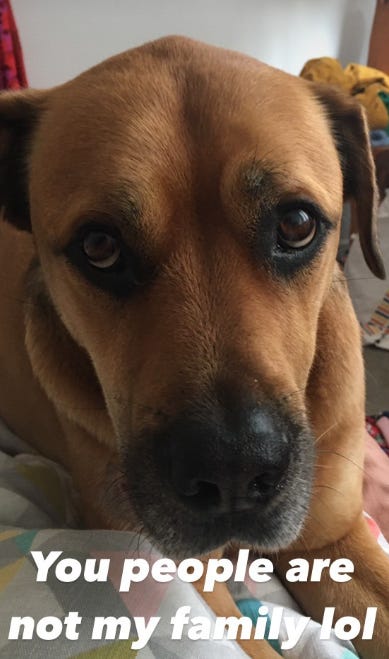
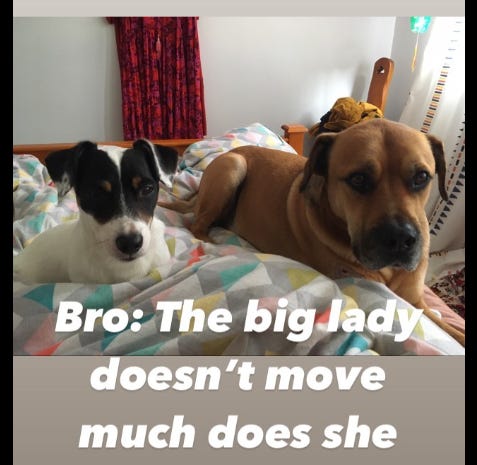
Becky was off to Rakiura with her whānau and I’d agreed to look after Bro, their big tan softy of a dog who looks like a killer but with eyes that are rimmed by kohl. Unfortunately Bro had been attacked on their way down the motu and he arrived wearing a cone of shame so he couldn't lick the gaping wound on his leg. Becky explained all his medicines to me and then readjusted his cone. She apologised to Bro for the noisy Velcro and told him it must be too loud for his ears. I mention this incident because it shows Becky’s preternatural empathy for all living things, not just people and because this ability to feel what others are experiencing is one of her many gifts as a writer.

I posted regular updates of Bro sharing my bed with my miffed Jack Russell to alleviate Becky's anxiety about leaving him with me.
One of my only quibbles with Auē was the fate of Lupo the dog. And the genesis of Kataraina came from a desire to rewrite the tragedies of Auē. When she first told me of her plan to use time travel as a means of ‘fixing’ Auē I was dubious and suggested she read Atonement by Ian McEwan which also focuses on a wish to go back and make things right but cheats the reader in a way that leaves us breathless. She dutifully read Atonement but the swamp which was intended as a means of undoing the past stayed. It morphed and became an extension of Kat who is now known as Kataraina, her full Māori name. I began by asking Becky to explain the swamp. Why does it bubble up, why does it start to rebel? I wanted to know if it was a character in itself or a plot device (because Auē was so heavily plotted) or both?
Becky: Well the swamp starts to bubble up because Stu is no longer there to control it, who was always trying to get it to yield to him. It’s rise is also supernatural and mystical (chuckles). And I wanted to tie the fucked up way women are treated to our treatment of the whenua. I am not an environmentalist and I don't always have the capacity to think about the environment…
Me: but you do like to get out there amongst it
Becky: I do I do, I fucking love getting out into the ngahere and that was my childhood, running amok in those sorts of spaces…and I feel like with Kat there was all these pockets of yucky stuff she was holding and I felt like the swamp was an interesting way to mirror her because a swamp can be quite frightening but also kind of beautiful and messy and fucked up but also so essential.
Me: so is it a metaphor or a plot device or both?
Becky: Well a metaphor to start with but I don't really feel like it's a plot device it just started off in my brain as something I couldn't leave alone
Me: so when you started Kataraina the swamp came first?
Becky: I wrote heaps of crap about the swamp first
Me: is that the 50 000 words that you were unflinching about chopping at the start of the Burns Fellowship
Becky: Yea I just slashed them but some of the essence of the swamp stayed.
Me: I think maybe you are more ruthless as a writer than people realise. And very tenacious.
Becky: hm, but also I realised I couldn't undo Auē. I couldn't undo the integrity of that story. And that like life we lose people, terrible things happen. People die and it can't be undone.
Me: The other thing I'm curious about is the can opener because I remember you read the passage about Kataraina and the creamed corn and the way she hacks at the tin at the Dunedin writers fest early in 2021 but then the can opener also acts like the swamp. It becomes a portal to the past. So which came first, Kataraina or the mysterious wahine of the swamp?
Becky: originally it just started with her hacking at the can with a knife because there is no can opener to hand
Me: yea but not all of us are going to risk losing our hands by using a knife but yea I've had to do it
Becky: and then the can opener just popped into my head and it was like you said with the gun in Auē, eventually it just has to pop off.
Me: actually it was Chekhov who said that but I’ll take it.
Becky: well it feels wanky to talk about what things symbolise so I’ll just leave it at that
Me: well it's like the swamp though, I mean as much as they are symbolic they also further the plot and Auē was very driven by a need to know what happens next and I think that's partly because Tim, your husband, was your first audience and because you were trying to entice a non-reader so it needed those sensational acts of violence to hold his attention. It's probably his fault it became such a bestseller(chuckles). Whereas Kataraina also jumps around in time but in a different kind of way, in a more literary way.
Do you think it's possible to read one without the other?
Becky: Well people have said they’ve had to go back and read Auē before getting into Kataraina. I suppose they could stand alone but for me I'm glad they are together. Now you can't have Auē without Kataraina.
Me: so is it going to be a trilogy or have you already started working on something else? Is it that idea you had about affairs in a small town
Becky: yea I’ve already started working on that one. It starts with three couples sitting at a table drinking.
Me: I’d read the heck out of that. The other thing I wanted to ask you about is the ‘greenness’ that Kat experiences. It it a nausea or something else?
Becky: it's partly a nausea but it's also about the leeching of her colour. The pale green is a sickness it's the colour of the caterpillar that she squashes on her leg after she realizes the older man has used and discarded her and when she is older and in the coma she is drained of all colour and the swamp, as it rises, is what gives her colour back to her. It’s a rich green. It is the colour of vitality.
Me: Like pounamu?
Becky: yea like pounamu. Like all the rich greens.
Me: finally I have to confess I missed the antics of Beth & Ārama. I even missed Jade and her suffering. I want to know if you missed writing about the children?
Becky: Yea I did but because I was so focused on Kataraina I had to show that Ārama’s presence in the house, and the attention she has to give him is also what is driving her relationship with Stu to breaking point. He resents any care she shows to others. And while Kat doesn't hold Ārama responsible she is quietly nursing her own resentments because she has taken on a role when she is being abused and Colleen and Henare in their grief have basically chosen to leave her to it.
Me: We have this burden as Māori writers of having to be careful about what we reveal about our lives and what we leave out. But I also believe that this is what gives our work this secret tension. Is it true that you felt cursed after writing Auē, like you had stepped too far into what can't be touched because of that irresistible urge to tutū?
Becky: remember I told you about the rats
that washed up on the beach in Westport. Not just a few rats, thousands of them, and other animals too. And I was flying back from some writer's festival when I heard the news and I felt responsible, like I had brought the badness to Westport. I thought the rats on the beach were all my fault.
Me: well I doubt it. But there is something that happens when we write where even reality feels touched by the magic of the mahi and where everything is about the book and because of the book. My friend Justine has a better word for this feeling than cursed. She said it makes the world glow.
Becky: Glow?
Me: yea glow. Hopefully our best work makes the world glow for the reader too. This is what Kataraina did for me.
https://bookhub.co.nz/p/kataraina